


Blog | AUGUST 2026
Improving STAR and HEDIS Performance Without Launching Another Program
The next quality opportunity may be making existing initiatives easier for members to understand, navigate, and act on.

Health plans are under sustained pressure to improve STAR ratings, HEDIS measures, CAHPS performance, medication adherence, preventive care completion, and the overall member experience. The pressure is visible in recent results: only 40% of Medicare Advantage plans earned four stars or higher for 2025, and 62% of members were enrolled in those higher-rated plans, down from 74% the year before (CMS, 2024).
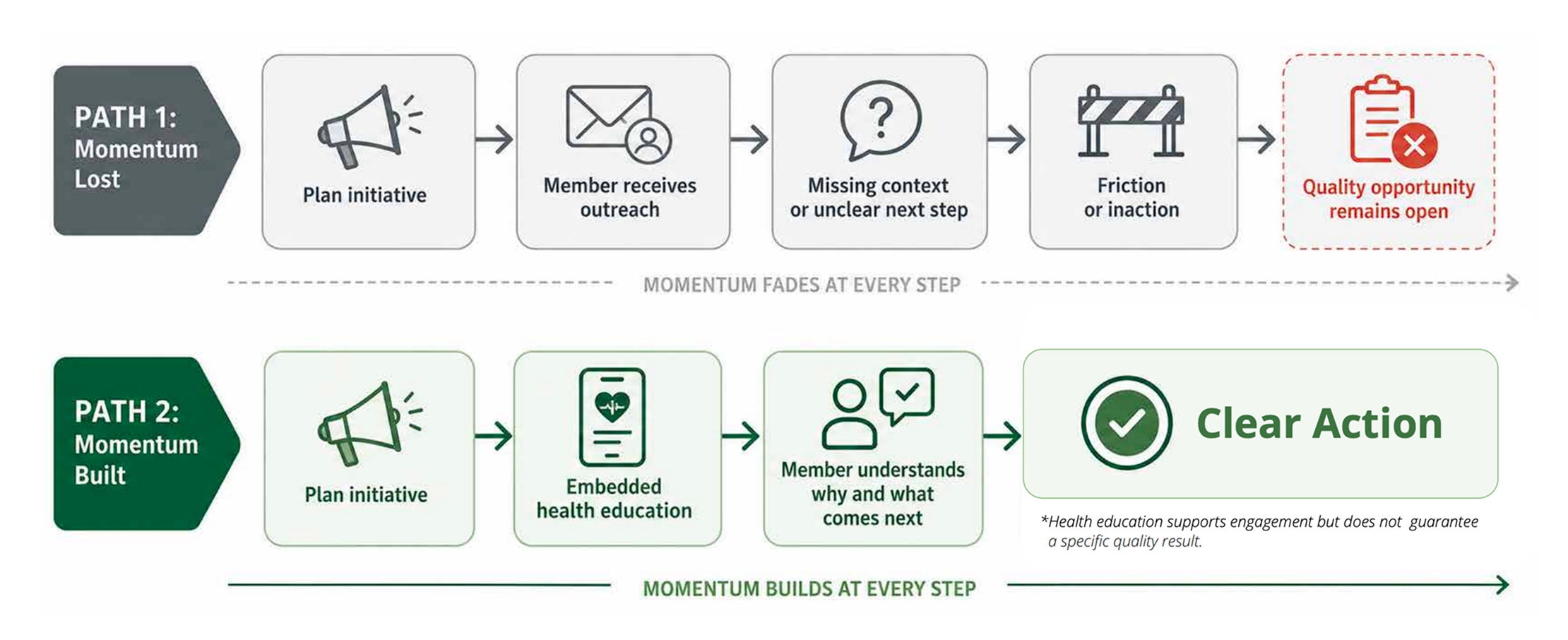
The instinctive response is often to add another campaign, another reminder stream, or another standalone program. But many plans do not have a shortage of programs. They have a gap between what the plan provides and what the member understands well enough to do.
The programs already exist. Member action is still uneven.
Most health plans already support members through care management, wellness initiatives, preventive screening reminders, chronic condition programs, discharge follow-up, and medication adherence outreach. Each initiative may be strategically sound. Yet the expected action can still break down when members are unclear about what is being asked, why it matters, or what they should do next.
A screening reminder may arrive without enough context to overcome hesitation. A care management message may explain that outreach is available without helping the member understand how it fits into care. A medication reminder may prompt a refill while leaving broader questions about the condition or therapy unanswered.
Those are not necessarily failures of the program itself. They are signs that health education and engagement are operating as separate layers.
50% MEDIAN DROPOUT
A review cited by MedCity News reported a median dropout rate of 50% for app-based health education programs, with some programs reaching 80%. The issue is often not a lack of content, but where and how the content appears in the member journey.
- Source: MedCity News, 2025
Shift the question from
"What else should we launch?"
A more productive question for many payer teams is: How can we make the initiatives already in market
easier to understand, easier to access, and easier to act on?

Place relevant health education alongside preventive care reminders and quality outreach.
Support care management conversations with consistent, plan-approved explanations members can revisit after the interaction.
Connect condition and treatment education to the member portal, website, or digital workflow rather than sending members to search independently.
Use plain-language, mobile-friendly health education to clarify why an action matters and what the member can expect next.
Reinforce, rather than replace, the plan's clinical, care management, and provider-led programs.
Why health education matters to quality performance
Many STAR and HEDIS measures ultimately depend on behavior: completing a preventive screening, managing a chronic condition, remaining engaged with prescribed therapy, attending follow-up care, or understanding discharge instructions. Plans can create the opportunity for action, but members still need enough clarity and confidence to follow through.
Medication adherence illustrates the stakes. A 2025 narrative review reported that an estimated 27% to 40% of people prescribed medications for chronic conditions such as hypertension are not fully adherent, and poor adherence has been associated with higher hospitalization and mortality risk (Cureus, 2025). Understanding why a medication matters is one part of a much larger adherence equation that also includes access, affordability, side effects, complexity, and clinical support.
Embedded health education can help close the space between outreach and action. It can explain the purpose of a screening, provide understandable context around a diagnosis, reinforce a care plan, or help a member prepare for the next step. The value is not simply more content. It is relevant health guidance delivered within a familiar, plan-approved experience.
Make the digital experience work harder
For many plans, the most immediate opportunity is not a new platform. It is using existing digital touchpoints more intentionally. Health education can be embedded within member portals, public-facing health plan websites, campaign landing pages, care navigation resources, and other digital experiences where members already seek answers.
This approach can reduce the need for members to leave the plan experience, search the open internet, and sort through information of uneven quality. It also gives plans greater control over the context in which guidance appears and the member journey around it.
The strategic importance of that reinforcement is increasing. CMS has shifted Star Ratings weighting toward clinical outcomes and HEDIS-based measures, including reducing the weight of patient experience and access measures beginning with the 2026 Star Ratings (CMS, 2025). That makes clear, coordinated support for member action even more important.
How A.D.A.M. SmartEngage can help
A.D.A.M. Health, a business unit of Ebix, Inc., provides SmartEngage: a URAC-certified, evidence-based health education library designed to integrate with healthcare websites and portal environments. SmartEngage includes thousands of patient and consumer health articles, illustrations, animations, videos, and wellness tools, with English- and Spanish-language content available.
For health plans, SmartEngage can become part of the engagement infrastructure supporting existing quality, care management, and member experience strategies. Depending on the plan's digital architecture and governance, trusted content can be placed within portals, apps, websites, campaign experiences, and care management workflows the plan already approves and manages.
Embed URAC-certified health education into existing portals, apps, websites, and care management experiences.
Reinforce outreach, adherence, preventive care, and chronic condition programs with condition-specific explanations instead of requiring another standalone initiative.
Deliver plain-language, mobile-friendly content that supports member understanding around screenings, medications, follow-up care, and common health questions.
Help reduce the friction created when members must leave the plan experience to search for answers on their own.
The objective is not to claim that health education alone will improve a specific measure. It is to help members better understand the actions that existing quality programs are asking them to take.
Health education is intended to support, not replace, provider advice, emergency care, individualized clinical guidance, or the plan's clinical decision-making processes. Members should follow the guidance of qualified healthcare professionals and seek emergency care when appropriate.
Make what already exists easier to use.
Improving quality performance is rarely simple. It requires coordination across clinical, operational, digital, communications, and member experience teams. But the next opportunity may not require another standalone initiative.
It may begin by connecting health education to the programs already in place, so members encounter clearer explanations, stronger context, and more useful next steps at the moments when action matters most.
Turn existing member initiatives into
more guided experiences.
See how A.D.A.M. SmartEngage can bring trusted, evidence-based health education into health plan
websites, portals, and member engagement strategies.
References
- Centers for Medicare & Medicaid Services. 2025 Medicare Advantage and Part D Star Ratings Fact Sheet, Oct. 10, 2024.
https://www.cms.gov/newsroom/fact-sheets/2025-medicare-advantage-part-d-star-ratings - MedCity News. The New Game Plan for Star Ratings Must Start with Member Incentives, Feb. 12, 2025.
https://medcitynews.com/2025/02/the-new-game-plan-for-star-ratings-must-start-with-member-incentives/ - Onah, C.O., et al. Data-Driven Patient Engagement to Improve Medication Adherence: A Narrative Review of Targeted Outreach Across Health Systems. Cureus, Nov. 2, 2025.
https://www.ncbi.nlm.nih.gov/pmc/articles/PMC12672954/ - Centers for Medicare & Medicaid Services. 2026 Star Ratings Fact Sheet, 2025.
https://www.cms.gov/files/document/2026-star-ratings-fact-sheet.pdf


